

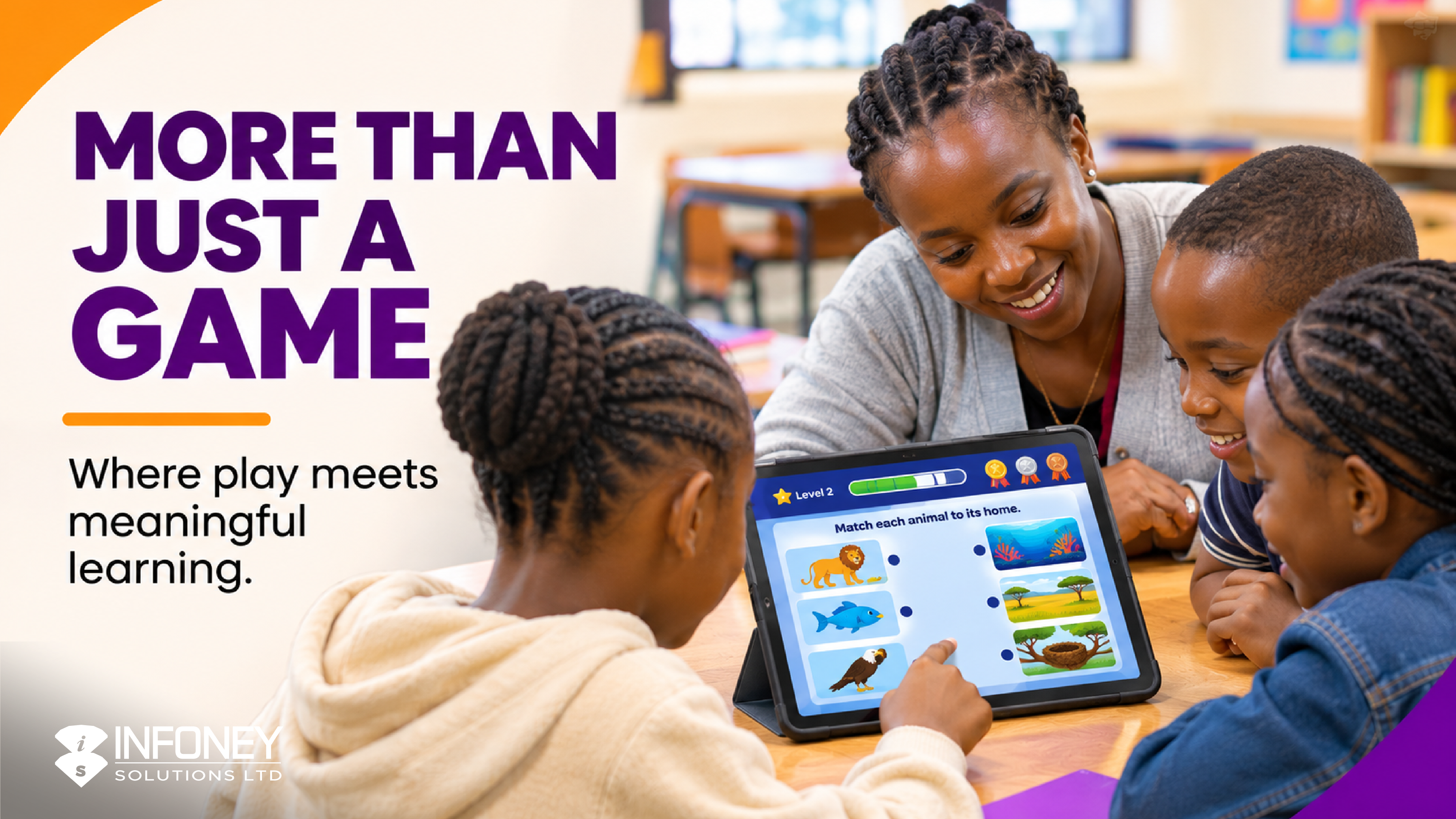
Learning Becomes More Enjoyable Through Play
Learning does not always have to involve reading notes, listening to explanations or answering questions on paper.
Sometimes, children engage better with concepts when they actively participate in activities that allow them to explore, experiment, solve problems and receive feedback along the way. This is where gamification in education comes in.
As technology continues to influence how learners access information and interact with educational content, gamification is becoming an increasingly useful approach to making learning more engaging.
Although incorporating game elements can make learning more engaging, an important question remains-Does making education feel like a game, contribute to meaningful learning?
What Is Gamification in Education?
Gamification in education involves incorporating game-like elements into learning activities to encourage participation, motivation and engagement.
These elements may include points and scores for completing activities, badges and medals for achieving learning milestones, and levels that learners progress through as they improve.
Unlike games designed purely for entertainment, educational gamification uses these elements to support specific learning objectives. The aim is to encourage learners to engage with educational content while developing knowledge and skills.
How Gamification Supports Learning
When thoughtfully incorporated into education, gamified activities create opportunities for learners to engage with concepts rather than simply memorizing information.
Here are some ways gamification can support learning:
It Encourages Active Participation
Gamified activities give learners opportunities to interact with the concepts they are studying rather than passively receiving information.
It Makes Practice More Engaging
Learners can revisit concepts through different activities and challenges, helping them reinforce their understanding while making practice more enjoyable.
It Provides Immediate Feedback
One advantage of interactive learning activities is the ability to provide instant feedback. This allows learners to identify mistakes, make corrections and improve their responses without having to wait for their work to be marked.
It Encourages Problem-Solving and Critical Thinking
Many educational games require learners to make decisions, identify patterns, organize information and find solutions to challenges.
For example, a learner completing a science simulation may need to experiment with different options to understand how a particular process works. Such activities encourage curiosity, reasoning and independent thinking.
Gamification with KlickIt Education Learning App
Interactive digital learning platforms make it possible to incorporate game-like elements into everyday learning experiences, giving children opportunities to practice what they learn in an interactive and engaging way.
The KlickIt Education learning app, incorporates gamified learning activities that allow learners to engage with educational content through different challenges and exercises.
Through activities such as quizzes, puzzles, matching exercises, crosswords and interactive simulations, learners get opportunities to test their understanding, solve problems and practice concepts covered in lessons.
The app also incorporates achievement-based rewards, including gold, silver and bronze medals, which recognize learners’ performance as they complete activities. These rewards introduce a sense of accomplishment and encourage learners to keep practicing.
Most importantly, the activities are designed around educational content, allowing learners to go beyond entertainment by recalling information, correcting mistakes and applying what they have learnt
Download the Android and Windows version of the KlickIt Education Learning App here:
Gamified Learning Is More Than Just Entertainment
Gamification is most effective when it complements well-planned teaching and learning activities. It does not replace teachers, structured lessons, practical experiences or meaningful classroom discussions.
Teachers continue to play an important role in explaining concepts, guiding learners, identifying learning gaps and providing additional support where necessary.
Instead, the aim is to create a balanced learning environment where traditional teaching approaches and interactive digital resources work together to support learners.
It is also important to remember that not every game-like activity automatically leads to better learning outcomes. For gamification to be effective, activities should be relevant to the subject, appropriate for the learner’s age and designed around clear educational objectives.