

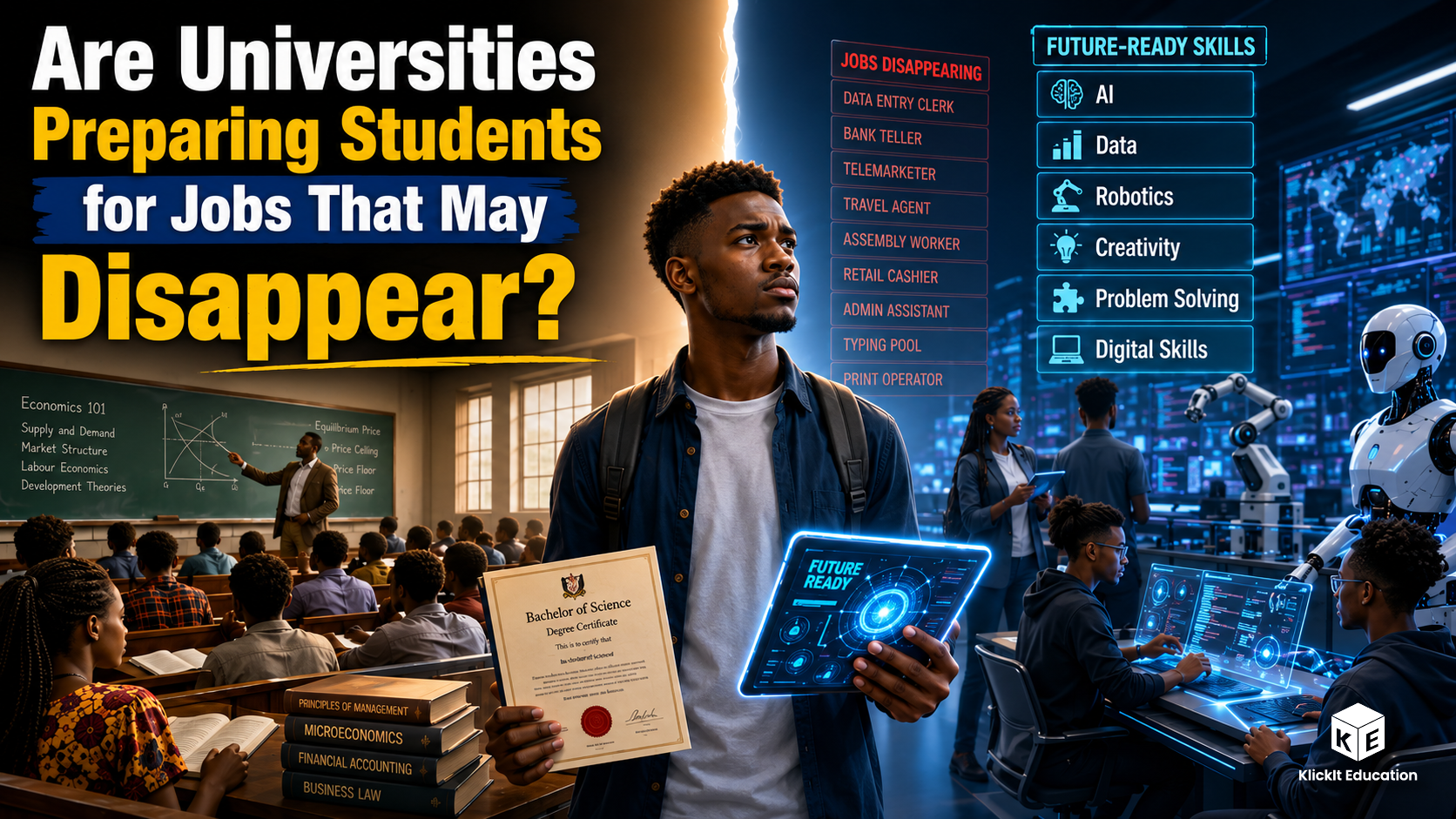
ARE OUR UNIVERSITIES PREPARING STUDENTS FOR JOBS THAT MAY NO LONGER EXIST?
Estimated reading time: 7 minutes
What if I told you that some students in our universities today may be studying for jobs that may not exist by the time they graduate?
That statement may sound harsh. It may even sound alarmist. But look around.
Artificial Intelligence is writing reports, coding software, designing graphics, analysing data, preparing legal drafts, supporting medical diagnosis, generating lesson plans, automating customer service, translating languages, creating marketing campaigns, and making business decisions faster than many entry-level workers can.
Robotics, automation, machine learning, data science, digital platforms, and intelligent systems are no longer distant technologies discussed in conferences. They are already entering banks, hospitals, farms, factories, classrooms, media houses, law firms, insurance companies, government offices, and businesses across Africa.
So, the real question for today’s university student is no longer simply: What course are you taking?
The bigger question is: Will your course still need you in five years?
And perhaps the even harder question for ministries of education, universities, TVET institutions, curriculum developers, and policymakers is this:
Are we preparing young people for the world that is coming, or are we still preparing them for the world that is disappearing?
The Degree Is No Longer Enough
For many years, education systems in Kenya and across Africa have carried one powerful promise: study hard, pass exams, go to university, get a degree, and secure a good job.
That promise is now under pressure.
A degree still matters. But a degree alone is no longer a guarantee of relevance. Employers are increasingly asking different questions. Can this graduate solve problems? Can they use digital tools? Can they work with data? Can they adapt quickly? Can they learn continuously? Can they think critically? Can they use AI ethically and productively? Can they create value beyond memorized theory?
The labour market is moving from certificate-based confidence to skills-based evidence.
This means a student may graduate with a good degree but still be unprepared for the workplace if the course content, teaching methods, assessment style, and practical exposure are outdated.
A student may know the theory of a profession but lack the digital ability to compete in that profession.
A student may spend four years studying for a role whose routine tasks are already being automated.
That is the danger.
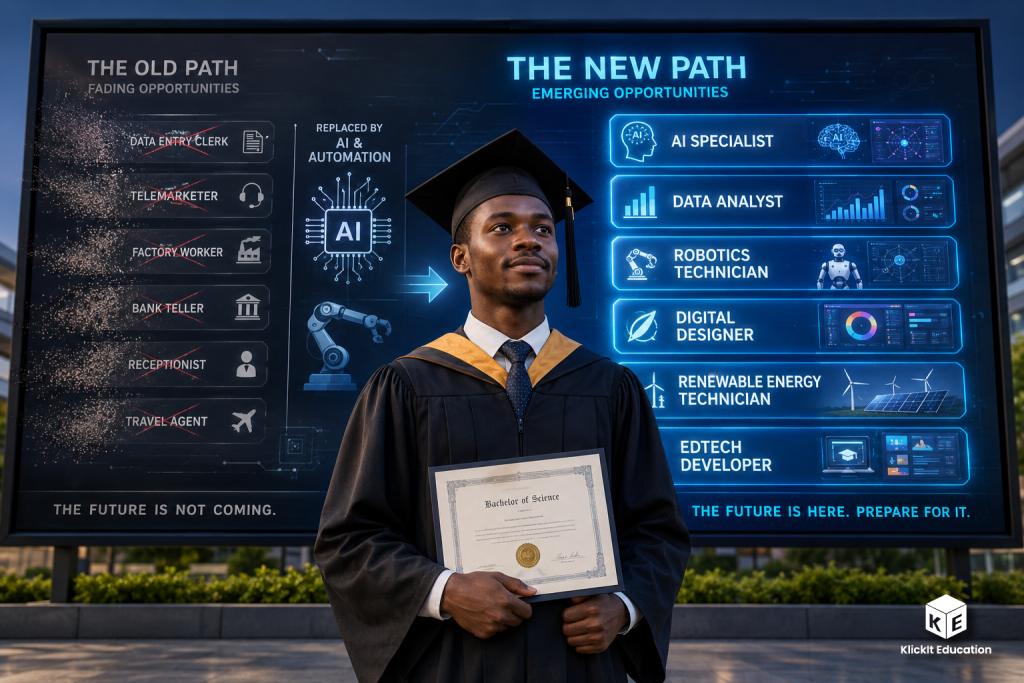
The future belongs to graduates who combine education with relevant, practical, and digital skills.
AI will not remove all jobs but it will change almost every job
The debate should not be reduced to fear. AI will not simply wipe out all professions. In many cases, it will create new opportunities, improve productivity, and make professionals more powerful.
But there is one truth we cannot ignore: AI may not replace every worker, but workers who know how to use AI may replace workers who do not.
The accountant of the future will not only understand accounting principles. They will use AI-powered tools for auditing, forecasting, fraud detection, tax analysis, and financial reporting.
The teacher of the future will not only deliver content. They will use digital platforms, learner analytics, interactive content, automated assessments, and personalized learning tools.
The doctor of the future will not only rely on memory and experience. They will work with AI-supported diagnosis, digital health records, remote monitoring, and predictive health systems.
The marketer of the future will not only write slogans. They will analyse customer data, use AI content tools, track behaviour patterns, and personalize campaigns in real time.
The engineer, journalist, architect, farmer, banker, administrator, designer, and public servant of the future will all work in environments shaped by intelligent technologies.
This means our education systems must stop asking only, “What should students know?”
They must also ask, “What will students still be needed for when machines can do the routine part?”
Kenya and Africa Cannot Afford Slow Education Reform
The world is not waiting for our committees to finish debating.
Technology is moving fast. Employers are adapting. Global competition is increasing. Young Africans are entering a labour market where they are not only competing with graduates from nearby universities, but also with digital workers, AI tools, remote freelancers, automation systems, and global talent platforms.
Kenya and Africa have one of the youngest populations in the world. That is a powerful advantage but only if the youth are prepared for the right future.
If millions of young people graduate with outdated skills, Africa’s demographic dividend could easily become a demographic crisis.
We may end up with educated unemployment: young people holding certificates but lacking market-relevant capabilities.
We may end up with universities producing graduates for jobs that are shrinking while industries complain that they cannot find the skills they need.
We may end up with institutions celebrating enrolment numbers while employers question graduate readiness.
That would be a failure of imagination, policy, and urgency.
Ministries of Education Must Move From Curriculum Review to Curriculum Intelligence
Traditional curriculum review is often too slow for the speed of technology.
By the time a course is reviewed, approved, printed, taught, examined, and graduated, the labour market may already have shifted.
Ministries of education across Africa need curriculum intelligence systems and continuous mechanisms that track labour market trends, emerging technologies, employer needs, global skills demand, and local development priorities.
Curriculum reform should not happen only after several years. It should be a living process.
Every ministry should be asking:
Which jobs are growing?
Which jobs are declining?
Which tasks are being automated?
Which skills are becoming essential across all professions?
Which courses have not changed meaningfully in the last five years?
Which university programmes have low employability outcomes?
Which industries are adopting AI, robotics, automation, and data systems fastest?
Which skills should every learner have regardless of course?
These questions should not be left to chance. They should guide policy, funding, accreditation, teacher training, university audits, and national education planning.
Universities Must Stop Teaching the Past as If It Is the Future
Universities must now become more honest with themselves.
A course cannot remain relevant simply because it has existed for decades.
A department cannot remain important simply because it has many students.
A lecturer cannot continue teaching the same notes for ten years while the industry has changed completely.
An institution cannot claim to prepare students for the future while its teaching methods, labs, assessments, research agenda, and industry linkages are stuck in the past.
The university of the future must become a place where students do not just consume knowledge but a place where they create, test, build, question, innovate, and solve real problems.
Every course should have a technology component.
Every student should graduate with digital confidence.
Every department should have industry partnerships.
Every programme should be reviewed against labour market realities.
Every lecturer should be trained to integrate technology into teaching.
Every assessment should test application, not just memory.
Every institution should ask: “If AI can answer this exam, what exactly are we testing?”
That question alone can transform higher education.

Education must prepare students for the workplace they are entering, not the one that existed years ago.
TVET Institutions Have a Historic Opportunity
While universities debate theory, TVET institutions can become Africa’s engine of practical transformation.
The future will need technicians who can install, repair, operate, maintain, and innovate around emerging technologies.
Africa will need people skilled in renewable energy systems, smart agriculture, robotics maintenance, electrical automation, digital fabrication, coding, machine operation, mechatronics, healthcare technology, construction technology, and modern logistics.
But this will only happen if TVET is not treated as a second option for those who “failed” to go to university.
TVET must be repositioned as a frontline pathway to the future economy.
A young person who can build, repair, program, operate, and manage intelligent systems may be more employable than a graduate with a theoretical degree and no practical skill.
Kenya and Africa must stop worshipping degrees and start respecting competence.
A Wake-Up Call to Education Leaders
To ministries of education: move faster. The world is not waiting.
To universities: audit your courses before the labour market does it for you.
To TVET institutions: rise boldly; the future economy needs practical innovators.
To lecturers: update your content, methods, and tools.
To parents: do not only ask what course your child is taking. Ask what skills they are building.
To students: your degree is the beginning, not the destination.
To employers: partner with institutions instead of only complaining about unemployable graduates.
To African governments: education reform is no longer just a social agenda. It is an economic survival strategy.