

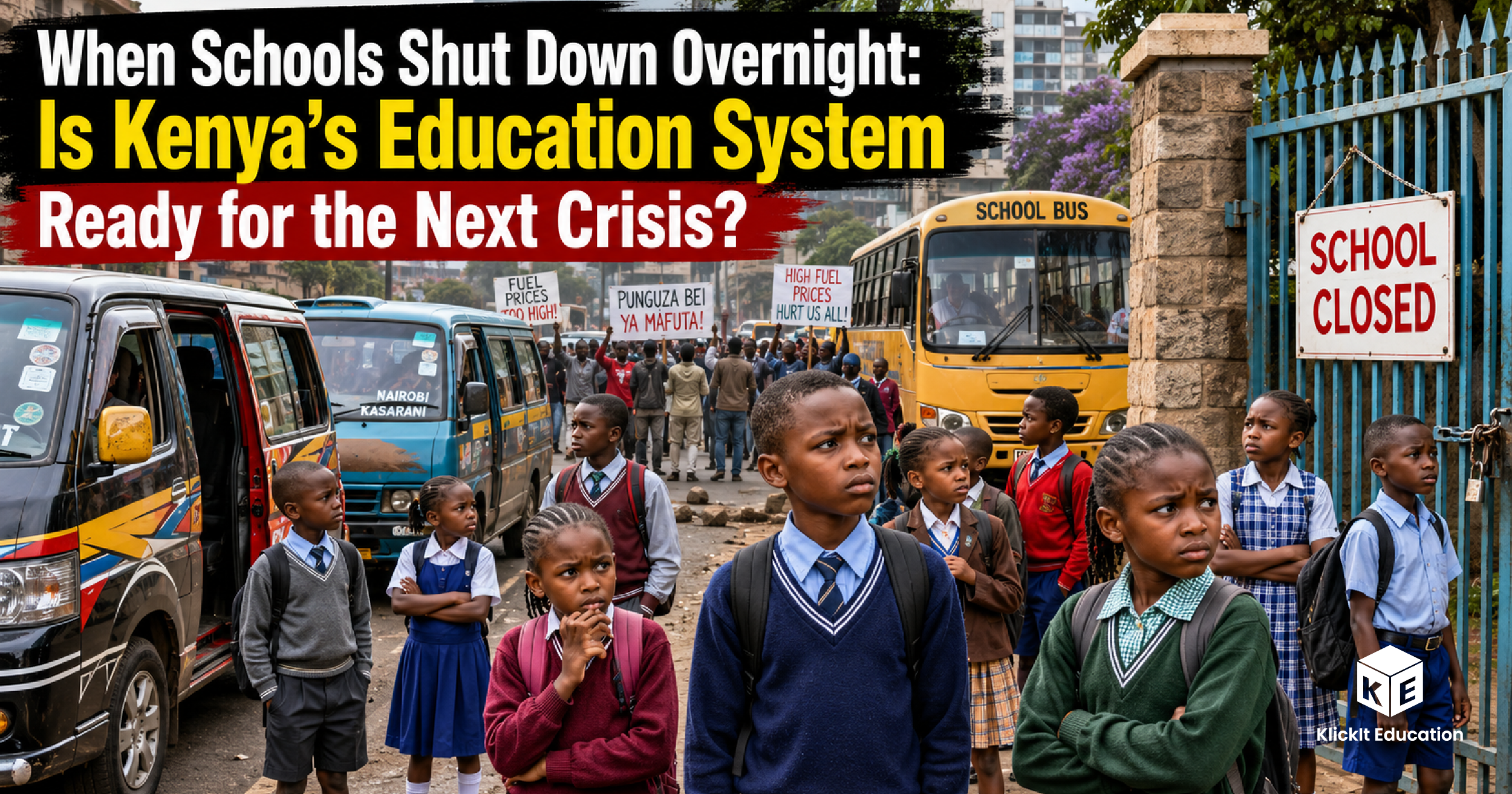
When Schools Shut Down Overnight: Is Kenya’s Education System Ready for the Next Crisis?
Estimated reading time: 5 minutes
School gates closed. Buses grounded. Parents frustrated. Teachers uncertain.
For many school owners and managers in Kenya, this situation is no longer unusual. Whether caused by floods, fuel shortages, political unrest, or public health emergencies, disruptions to learning are becoming more frequent and more costly.
Kenya’s education sector has already experienced major interruptions in recent years. In 2024, severe floods forced the postponement of school openings and affected millions of learners. In addition, election-related protests and unrests have repeatedly interrupted learning in several parts of the country every other election cycle. The COVID-19 pandemic also exposed how vulnerable traditional learning systems can be when physical classrooms suddenly become inaccessible.
As the country approaches future political, health and economic uncertainties, one important question emerges for every educator and school leader:
Is your school designed to survive disruption?
Most schools still operate on one fragile assumption: that learners must physically attend school every day for learning to happen. But in today’s unpredictable environment, relying entirely on physical attendance is becoming a serious operational risk.
The Hidden Cost of School Disruptions
When schools close unexpectedly, the impact goes far beyond missed lessons.
1. Learning Loss
Even short interruptions can significantly affect learners, especially in foundational literacy and numeracy skills. Research by organizations such as UNICEF and Save the Children shows that prolonged breaks from structured learning can lead to major academic setbacks, reduced learner engagement, and missed curriculum coverage that becomes difficult to recover within the academic calendar. Globally, the World Bank has warned about rising “Learning Poverty,” where many children struggle to read and understand age-appropriate text. With the repeated disruptions, these learning gaps grow even wider, making every lost day critical for Kenyan schools and learners.
2. Financial Pressure on Schools
Disruptions also create financial stress for institutions.
When learners stop physically attending school, many parents delay fee payments because they feel educational services are no longer being fully delivered. However, school expenses do not stop. Salaries, rent, utilities, maintenance, and administrative costs continue regardless of whether classrooms are occupied.
This creates cash flow challenges that can affect school stability, staff morale, and long-term growth.
Schools Must Shift from Reactive to Resilient
Many institutions still treat disruptions as temporary emergencies. But the reality is that disruptions are now part of the education environment.
Forward-thinking schools must begin building systems that can continue operating even when physical learning is interrupted.
The goal should no longer be:
“How do we pause and wait?”
Instead, schools should ask:
“How do we continue learning no matter what happens?”
What a Resilient School Model Looks Like
A resilient school is not fully dependent on one physical location. It combines classroom learning with flexible digital support systems that can activate whenever disruptions occur.

1. Build a Distributed Learning System
The classroom should remain important but it should not be the only place where learning can happen.
Schools need systems that allow teachers, learners, and parents to remain connected all the time including during interruptions. This may include:
- Digital learning platforms
- Structured home assignments
- Interactive assessments
- Recorded lessons
- Revision activities accessible from home
Schools that already have these systems in place recover faster during crises and maintain stronger parent confidence.
2. Use Technology Practically
During the COVID-19 lockdowns, many institutions tried to replicate full classroom schedules using live video sessions. However, this approach proved difficult for many Kenyan families due to:
- High internet costs
- Limited access to devices
- Unstable connectivity
Technology in education should not always aim to fully replace the classroom. Instead, it should act as a practical bridge that keeps learning continuously active.
The best digital learning solutions for Africa are:
- Low-bandwidth
- Mobile-friendly
- Easy to use
- Accessible offline where possible
- Affordable for parents and schools
3. Support Parents as Learning Partners
When schools close, parents and guardians naturally become part of the learning process.
Schools that provide clear guidance, structured learning paths, and simple progress tracking help families support learners more effectively from home.
This strengthens the relationship between schools and parents while helping learners stay academically engaged.
How KlickIt Education platform Supports School Resilience
For schools looking to strengthen continuity and reduce disruption risks, KlickIt Education Platform by Infoney Solutions Limited provides a practical and scalable solution designed specifically for the Kenyan education environment.
KlickIt Education helps schools maintain academic continuity even when physical learning is disrupted.
- Low-Bandwidth and Accessible Learning
One major challenge in digital learning is internet cost. KlickIt Education is optimized for offline and low-bandwidth environments, making it easier for learners to access educational content without requiring expensive internet packages.
This is especially important in Kenya and across Africa, where affordability remains a key factor in EdTech adoption.
- CBC-Aligned Interactive Learning
The platform provides:
- CBC-aligned lessons
- Interactive activities
- Assessments and quizzes
- Revision materials
- Progress tracking
This allows learners to continue engaging with the curriculum even outside the classroom.
- Academic Continuity for Schools
Instead of teachers rushing to create emergency digital materials during a crisis, schools can rely on a ready-made system that supports ongoing learning.
This helps reduce:
- Learning gaps
- Academic regression
- Pressure on teachers
- Parent frustration
- Strong Parent and School Visibility
KlickIt Education also gives parents and schools visibility into learner progress. Schools can continue monitoring engagement and performance even during interruptions, helping maintain accountability and educational value.
The Future of Education Requires Resilience
Disruptions are no longer rare events. Climate challenges, economic instability, transport issues, and political uncertainty will continue affecting education systems.
Schools that prepare early will not only survive these disruptions, they will build stronger trust with parents, improve operational stability, and protect learner outcomes.
The future belongs to institutions that can continue delivering learning regardless of circumstances.
For school owners, directors, and education leaders, resilience must now become part of school design itself. Because when the school gates close, learning should not stop.